
Hindustan Coca-Cola Beverages has moved the National Green Tribunal, challenging the order.

Of 817 grossly polluting factories, 62 have not installed anti-pollution devices and in 84 units, the installed devices are non-functional.
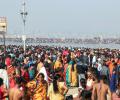
The National Green Tribunal on Wednesday slammed the Uttar Pradesh Pollution Control Board, asking whether it disputed the Central Pollution Control Board's finding on high levels of faecal coliform being found in the water at various locations in Prayagraj during the ongoing Mahakumbh.

Uttar Pradesh Chief Minister Yogi Adityanath asserted that Uttar Pradesh enjoys a clean environment, unlike Delhi, which he likened to a 'gas chamber' due to its pollution levels.
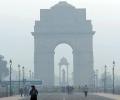
'Most pollution boards across the country have unused funds. There is practically no reason why pollution should not be a political priority.'

Uttar Pradesh Chief Minister Yogi Adityanath on Wednesday dismissed concerns regarding faecal contamination in the waters at Triveni Sangam, stating that continuous monitoring and purification processes ensure its quality.

Mundane as it may seem, this is in some ways a metaphor for the challenges facing the nation, argue Arvind Subramanian and Devesh Kapur in their new book, A Sixth Of Humanity.

The Supreme Court on Wednesday rapped the Haryana and Punjab governments over non-prosecution of violators found guilty of stubble burning and summoned the state chief secretaries to appear before it on October 23 and submit. an explanation.

The Supreme Court on Wednesday asked the Commission for Air Quality Management (CAQM) to consider directing schools in Delhi-NCR to postpone open air sports competitions planned in November and December to 'safer months' keeping in mind air pollution levels.
The eight critically polluted areas are Ludhiana (Punjab), Varanasi-Mirzapur (Uttar Pradesh), Agra (Uttar Pradesh), Bhavnagar (Gujarat), Cuddalore (Tamil Nadu), Dombivalli (Maharashtra), Aurangabad (Maharashtra) and Navi-Mumbai (Maharashtra).
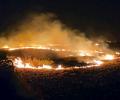
The Supreme Court has expressed concern over the increasing pollution levels during winter and has suggested that the Punjab government arrest farmers who engage in stubble burning. The court believes that this action would send a strong message and help curb air pollution.

'The US was well aware of the nationality of the seafarers on board the vessels. It was not hidden. The nationality of those aboard a merchant ship is known to all the ports.' 'So, why did US shoot a missile that resulted in the deaths of the Indian mariners?'

The petition alleged that "illegal mining" was being carried out by Singh, the MP from Kaiserganj, in Majharath, Jaitpur and Nawabganj villages of Tarbganj tehsil in the district.
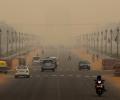
Sunil Bharala, the chairman of the state Labour Welfare Council, said stubble burning is an 'age-old practice'.

Buildings were decorated with colourful lights and earthen lamps dotted houses as people across the country thronged temples and celebrated Diwali with pomp on Monday.

PM2.5 pollution in the national capital has reduced by over 7 per cent in four years, from 108 micrograms per cubic metre in 2019 to 99.71 micrograms per cubic metre in 2022, the report by NCAP Tracker said.

Authorities have suspended civil construction works in Delhi and Haryana as part of emergency measures to improve air quality.
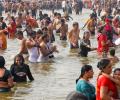
A new report by the Central Pollution Control Board (CPCB) submitted to the National Green Tribunal has said that the water quality during the recently concluded Maha Kumbh in Prayagraj was fit for bathing, despite earlier reports indicating otherwise. The report, based on statistical analysis of water samples collected during the Kumbh, found that the median values for key parameters like pH, dissolved oxygen, biochemical oxygen demand, and fecal coliform count were within permissible limits. However, the report acknowledges significant variability in data due to factors like upstream activities and sampling conditions. The matter is set for hearing on April 7.
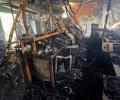
A preliminary inquiry suggests electric firecrackers caused a devastating nightclub fire in Goa, resulting in 25 deaths. The incident has exposed illegalities and lax enforcement of safety rules.

The Supreme Court has permitted the sale and bursting of green crackers in Delhi-NCR for Diwali, relaxing the ban on green firecrackers as a temporary measure from October 18 to 21. The court has asked pollution control boards to monitor pollution levels and file reports. The order also includes measures to prevent the sale of non-compliant crackers.

The Congress on Friday claimed that a 'silent undercurrent' is brewing across western Uttar Pradesh against the 'failures' of the Modi government, as it flagged issues such as 'neglect' of sugarcane farmers and examination paper leaks.

The Uttar Pradesh government, citing a scientist, has asserted that Ganga water at the ongoing Maha Kumbh in Prayagraj is as pure as "alkaline water", debunking concerns raised by the Central Pollution Control Board (CPCB) about water quality. The government claims that a scientist found no bacterial growth or decline in the water's pH level, despite millions of devotees bathing in the river. However, experts caution that the quality of the Ganga water is not static and can vary greatly depending on various factors.
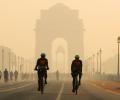
Violation of the provisions entails a punishment of a jail term up to five years or with fine up to Rs 1 crore or with both, the ordinance released by the Ministry of Law and Justice on Thursday said.

The Centre directed Uttar Pradesh and Bihar on Sunday to prevent dumping of dead bodies in the Ganga and its tributaries, and focus on their safe disposal and a dignified cremation after corpses were seen floating in these rivers following a spurt in the number of coronavirus cases.
The Ganga water at the Triveni Sangam in Prayagraj, where lakhs of people are taking a holy dip every day during the ongoing Maha Kumbh, is currently unsafe for bathing as it exceeds the prescribed limit for biological oxygen demand (BOD), a key parameter to determine water quality, according to government data.
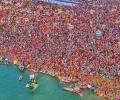
The Indian government has stated that the water in the Ganga river at Triveni Sangam in Prayagraj was fit for bathing during the recently concluded Maha Kumbh, citing a new report from the Central Pollution Control Board (CPCB). The report, however, contradicts an earlier CPCB report that found high faecal coliform levels at several locations in Prayagraj during the Maha Kumbh. The government also highlighted measures taken to ensure water quality during the event, including the installation of sewage treatment plants and the use of advanced oxidation techniques to treat wastewater.
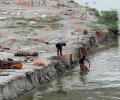
The Centre is conducting a study to assess the presence of SARS-CoV-2, or novel coronavirus, in the Ganga as corpses were found dumped in the river during the second Covid wave, and were fished out from districts in Uttar Pradesh and Bihar, officials said.

The green panel said that innocent people drank and bathed in the river with reverence, without knowing that it may adversely affect their health.

Air quality index (AQI) soared past 350 level in parts of Delhi on Thursday and experts cautioned that as weather turns colder it may breach the 400-mark ceiling and enter the 'severe' zone soon, notwithstanding the incidents of stubble burnings which have nosedived from 17,529 in 2020 to 4,262 this year.

The Uttar Pradesh government is taking comprehensive measures to ensure the Ganga River is "dip-safe" during the Maha Kumbh, a massive religious gathering. This includes daily water testing, a 200-km temporary drainage system for greywater, and state-of-the-art technology to manage human waste. Authorities are also emphasizing the importance of keeping the river clean by removing pooja waste and encouraging the use of reusable items.

Delhi's air quality deteriorated significantly on Monday, with areas like Dwarka, Mundka and Najafgarh recording an AQI of 500, the worst this season. The city's overall AQI reached 491, triggering the implementation of the Graded Response Action Plan (GRAP) Stage-IV restrictions in Delhi-NCR. Doctors warned of health risks, urging people to wear N95 masks and avoid outdoor activities. The Supreme Court questioned the Delhi government on its anti-pollution measures and warned against scaling down preventive measures without its permission. Delhi Chief Minister Atishi accused the BJP-led central government of political maneuvering while neglecting stubble burning in states it governs. Meanwhile, the city enforced stricter pollution control measures, including a ban on truck entry and suspension of construction activities. Air purifier sales surged, reflecting the public's concern over the severe air pollution.

Violation of the provisions entails a punishment of a jail term of up to five years or with fine up to Rs one crore or with both.
The top court did some tough-talking and had warned that the administration at large will be made accountable even if there is a single incident of stubble burning henceforth.

Delhi's air quality plummeted to alarming levels on Tuesday after 24 days, with many areas witnessing a significant spike in pollution despite the strictest measures, including a ban on construction activities and the entry of trucks into the city, coming into force.
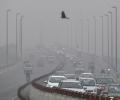
With Delhi recording air pollution levels seven to eight times above safe standards on Monday, the city government announced the return of its flagship odd-even scheme after four years anticipating further deterioration of air quality post-Diwali.
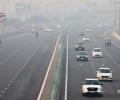
The city's 24-hour Air Quality Index (AQI), recorded at 4 pm daily, stood at 417, making it the worst in the country. On Friday, the AQI level was 396.

A bench of Chief Justice DY Chandrachud and justices PS Narasimha and JB Pardiwala passed the order after hearing an application of Uttar Pradesh government seeking more time to install and operationalise 100 per cent STP coverage in the state.

Report by Greenpeace also presented a grim picture of India's pollution level.

The poisonous haze has been causing significant problems for people with existing respiratory issues, according to doctors.

Delhi's overall air quality index (AQI) stood at 463 at 11.30 am, according to the System of Air Quality and Weather Forecasting and Research (SAFAR).
